





Educational Programs
The educational programs offered in Catholic Schools in Ontario are offered in accordance with the guidelines published by the Institute for Catholic Education and approved by the Asssembly of Catholic Bishops of Ontario.
To access the Guidelines, click on the titles below:

| Kindergarten - In God's Image (CCCB) | ||||||||||||||||||||||
|
This program affirms the 4-5 year old child as someone who is made in
|
||||||||||||||||||||||
| Grade 1 - Growing in Faith; Growing in Christ 1 (ACBO) | ||||||||||||||||||||||
|
Scripture Stories The following key Scripture stories appear throughout Grade 1 and are fully illustrated:
Additional Scripture stories are explored in the Teacher Resource:
Prayers of the Church
Sacramental Focus*
*Note that information on all the sacraments is scaffolded throughout the program.
Saints Illustrated stories of the following saints appear in the resources for Grade 1:
Theological Emphases in Grade 1
|
||||||||||||||||||||||
| Grade 2 - Growing in Faith; Growing in Christ 2 (ACBO) | ||||||||||||||||||||||
|
Scripture Stories The following key Scripture stories appear throughout Grade 2 and are fully illustrated:
Additional Scripture stories are explored in the Teacher Resource:
Prayers of the Church
The following prayers from Grade 1 are also included:
Sacramental Focus*
*Note that information on all the sacraments is scaffolded throughout the program.
Saints Illustrated stories of the following Saints appear in the resources for Grade 2:
Theological Emphases in Grade 2
|
||||||||||||||||||||||
| Grade 3 - Growing in Faith; Growing in Christ 3 (ACBO) | ||||||||||||||||||||||
|
Scripture Stories The following key Scripture stories appear throughout Grade 3 and are fully illustrated:
Additional Scripture stories are explored in the Teacher Resource:
Prayers of the Church
The following prayers from Grades 1 and 2 are also included:
Sacramental Focus*
*Note that information on all the sacraments is scaffolded throughout the program.
Saints Illustrated stories of the following Saints appear in Grade 3:
Theological Emphases in Grade 3
|
||||||||||||||||||||||
| Grade 4 - Growing in Faith; Growing in Christ 4 (ACBO) | ||||||||||||||||||||||
|
Scripture Stories The following key Scripture stories appear throughout Grade 4 and are fully illustrated:
Prayers of the Church
The following prayers from Grades 1 to 3 are also included:
Sacramental Focus*
*Note that information on all the sacraments is scaffolded throughout the program.
Saints Illustrated stories of the following Saints appear in the Grade 4 Student Book:
Theological Emphases in Grade 4
|
||||||||||||||||||||||
| Grade 5 - Growing in Faith; Growing in Christ 5 (ACBO) | ||||||||||||||||||||||
|
|
|
|
Prayers of the Church
|
|
The following prayers from Grades 1 to 4 are also included:
|
|
Sacramental Focus*
- Baptism
- Reconciliation
- Anointing of the Sick
- Holy Orders
*Note that information on all the sacraments is scaffolded throughout the program.
Saints and Holy People
Features and stories of the following Saints and Holy People appear in the Grade 5 Student Book:
|
|
Theological Emphases in Grade 5
|
Strand of Religious Education |
Theological Emphases |
|
Believing |
God’s Self-Revelation in the person of Jesus Christ through Sacred Scripture and Tradition The Creed as a Summary of Catholic Belief and a Profession of Faith In God’s Plan of Salvation Christ founded the Church with the following marks: One, Holy, Catholic, and Apostolic |
|
Celebrating |
The Seven Sacraments of the Church – Sacraments of Initiation: Baptism, Confirmation, Eucharist: Sacraments of Healing: Reconciliation and Anointing of the Sick; Sacraments of Service: Holy Orders and Marriage The Mass as the source and summit of Christian life The Celebrations of the Church’s Liturgical Year |
|
Living a Moral Life |
Christian Morality as a living response of our human vocation to life in the Spirit as revealed by reason (Natural Law), the Scriptures and Tradition Freedom and Responsibility, Reason, Conscience, and Conscience Formation Grace, Virtue, Holiness and Sin and Forgiveness |
|
Living in Community |
Living in the Church as members of the Body of Christ The Communion of Saints |
|
Living in Solidarity |
Living our Christian vocation within the human community Social Justice Teachings of the Church Our mission to evangelize (i.e. proclaim the Gospel message) and to witness to Jesus Christ |
|
Prayer |
God’s universal call to prayer and our human response The Way of Prayer: Forms and Expressions of Prayer |
Scripture Stories
The following key Scripture stories appear throughout Grade 6:
|
|
Prayers of the Church
|
|
The following prayers from Grades 1 to 5 are also included in the Teacher Resource:
|
|
Sacramental Focus*
- Holy Orders
*Note that information on all the sacraments is scaffolded throughout the program.
Saints and Holy People
Features and stories of the following Saints and Holy People appear in the Grade 6 Student Book:
|
|
Social Justice Focus
Principle of Rights and Responsibilities
Understand that by virtue of our human dignity, out of respect for equality and diversity of being and the common good, all human beings are to enjoy certain fundamental human rights (e.g. the right to life, liberty, religious freedom, food, shelter, health care, education, and employment). [CCC nos. 1886-1896; 1928-1948]
Theological Emphases in Grade 6
|
Strand of Religious Education |
Theological Emphases |
|
Believing |
God’s Self-Revelation in the person of Jesus Christ through Sacred Scripture and Tradition |
|
Celebrating |
The Seven Sacraments of the Church—Sacraments of Initiation: Baptism, Confirmation, Eucharist: Sacraments of Healing: Reconciliation and Anointing of the Sick; Sacraments of Service: Holy Orders and Marriage |
|
Living a Moral Life |
Christian Morality as a living response of our human vocation to life in the Spirit as revealed by reason (Natural Law), the Scriptures and Tradition |
|
Living in Community |
Living in the Church as members of the Body of Christ |
|
Living in Solidarity |
We are called to live our Christian vocation within the human community (i.e. communal nature of our dignity as human beings) |
|
Prayer |
God’s universal call to prayer and our human response |
Scripture Stories
The following key Scripture stories appear throughout Grade 7:
- Sermon on the Mount
- The Book of Ruth
- The Wedding at Cana
- The Prodigal Son
- The Transfiguration on the Mountain
- The Agony in the Garden
- Jesus is Betrayed
- Peter Denies Jesus
- Jesus is Tried
- Jesus Suffers with His Cross
- Jesus Dies on the Cross
- Jesus is Risen
- Jesus Ascends
- Simon of Samaria
Prayers of the Church
- The Lord’s Prayer
- Hail Mary
- The Magnificat
- The Memorare
- Hail Holy Queen
- The Rosary
- The Chaplet of Divine Mercy
- The Angelus
- Liturgical Prayers of the Mass
- Prayers for Confirmation, Marriage, and Holy Orders
Sacramental Focus*
- Marriage
- Confirmation
- Holy Orders
*Note that information on all the sacraments is scaffolded throughout the program
Saints and Holy People
- Blessed Maria Gabriella Sagheddu
- St. Teresa of Avila
- St. Juan Diego
- Our Lady of Guadalupe
- St. Francis of Assisi and the first Nativity scene
- St. Andre Bessette
- St. Joseph
- St. John Bosco
- Disciple Stephen
- Apostle Andrew
- Apostle Philip
- Apostle James
- Apostle Paul
- St. Marie of the Incarnation
- St. Jerome
- St. Mariam Baouardy
- St. Lawrence
- St. Teresa Benedicta of the Cross (Edith Stein)
- Blessed Chiara "Luce" Badano
- Sts. Louis and Zélie Martin (St. Thérèse of Lisieux's parents)
- Sts. Perpetua and Felicity
- St. Jude
- St. Thomas More
- St. Oscar Romero
- Cardinal Thomas Collins
- Fr. John Comiskey
Social Justice Focus
- Solidarity
- Caring for People Who Are Poor and Vulnerable
- Community and the Common Good
- Participation in Society
Theological Emphasis
The grade 7 program is designed to draw the students into a deeper and more critically aware relationship with God. The program is founded in the six major areas of catechesis: What we Believe; Celebrating our Faith; Living a Morally Good Life; Living In Community; Living in Solidarity, and Nurturing a life of Prayer. The program explores the sacred mysteries of our faith revealed in Scripture, Tradition and the life of Jesus Christ and God’s revelation of Himself to humanity. Through the one, holy catholic and apostolic Church God, offers us salvation. This offer is explored through a study of the four stages of salvation history and the sacraments of Confirmation, Holy Orders, and Matrimony. The program also focuses on the personal encounter with Christ offered through His real presence in the Eucharist. A focused study of the Sermon on the Mount within the program looks at virtuous living and developing habits of prayer. Church teaching on social justice and the call to community and solidarity are examined though narratives and the lives of the saints with a particular emphasis on Mary Mother of Jesus and the many devotions to her prayed by the faithful.
Scripture Stories
- Jesus Cleanses the Temple
- Peter’s Declaration about Jesus
- The Transfiguration
- The Call of Matthew
- The First Sin and its Punishment
- Six Days of Creation and the Sabbath
- Jesus and Zacchaeus
- The Escape to Egypt
- Announcement to Zechariah
- Announcement to Mary
- Visitation to Elizabeth
- Birth of John the Baptist
- Revelation to Joseph
- Birth of Our Lord
- The Finding of Jesus in the Temple
- The Shepherds and the Angels
- Jesus’ Side is Pierced, the Death of Jesus
- Abuses at the Lord’s Supper
- The Boy Jesus in the Temple
- The Greatest Commandment
- The Temptation of Jesus
- Jesus Stills a Storm
- Jesus Prays on the Mount of Olives
- The Soldiers Mock Jesus
- The Crucifixion of Jesus
- The Walk to Emmaus
- Jesus and Thomas
- The Commissioning of the Disciples
- The Apostles Heal Many
- Paul and Silas in Prison
- The Conversion of Saul
- Paul’s Charge to Timothy
- The Promise of the Holy Spirit
- Instructions Concerning Prayer
Prayers of the Church
- Act of Spiritual Communion
- Anima Christi
- Daily Examen
- Divine Praises
- Eucharistic Prayer: Doxology
- Litany of Loreto (abridged)
- Litany of the Holy Spirit (adapted)
- Miraculous Medal Prayer
- Prayer Against Despair
- Prayer Before the Crucifix
The following prayers from Grades 1 to 7 are also included in the Teacher Resource:
Grade 1
- The Sign of the Cross
- The Lord’s Prayer
- Hail Mary
- Glory Be
Grade 2
- Apostles’ Creed
- Prayer to My Guardian Angel
- Holy, Holy, Holy
- Lord I Am Not Worthy
- Lamb of God
- Act of Contrition
Grade 3
- The Morning Offering
- Memorial Acclamation
Grade 4
- Hail, Holy Queen
- Prayer to the Holy Spirit
- Psalm 23
- Act of Contrition
Grade 5
- Act of Faith
- Act of Hope
- Act of Love
- Memorial Acclamation
- Nicene Creed
- Litany of the Saints
- Litany of the Holy Spirit
- Eucharistic Prayer: doxology
- St. Andrew Christmas Novena
Grade 6
- Prayer for Vocations
- Hail, Holy Queen
Grade 7
- The Magnificat
- The Memorare
- The Rosary
- The Chaplet of Divine Mercy
- The Angelus
- Liturgical Prayers of the Mass
- Prayers for Confirmation, Marriage, and Holy Order
Sacramental Focus*
- Confirmation
*Note that information on all the sacraments is scaffolded throughout the program
Saints and Holy People
- Apostle Peter
- Apostle Paul
- The Evangelists: Matthew, Mark, Luke, and John
- St. Francis of Assisi
- St. Clement I
- St. Dulce Lopes Pontes
- St. Josephine Bakhita
- St. John of Damascus
- St. Nicholas of Myra
- St. Gregory of Nazianzus
- St. Teresa of Calcutta
- St. Thérèse of Lisieux
- St. Margaret Mary Alacoque
- Blessed Pier Georgio Frassati
- Blessed Stanley Rother
- St. Longinus
- St. Hildegard of Bingen
- St. John of God
- St. Angela of Foligno
- St. John Paul II
- Blessed Carlo Acutis
- St. Gianna Beretta Molla
Social Justice Focus
- Rights and Responsibilities
Theological Emphases of Grade 8
|
Strand of Religious Education |
Theological Emphases |
|
Believing |
God reveals Himself through Sacred Scripture and Sacred Tradition and authenticated by the Magisterium God the Father, Son and Holy Spirit are one Through the Holy Spirit Christ remains present in the Church and in the world The Church is One, united in faith; Holy, sanctified by Christ; Catholic, founded for all people; and Apostolic through the legacy of the Apostles |
|
Celebrating |
Through the Holy Spirit, the sacraments are the source of grace Through the Mass we encounter Christ and fully participate in his passion and death The Liturgical year unifies the Church through the celebration of the paschal Mystery |
|
Living a Moral Life |
The Commandments, The Sermon on the Mount and the Beatitudes guide the moral life of followers of Christ We guide our moral life through our conscience, Sacred Scripture and the teaching of the Church We overcome sin by acknowledging our weakness and asking for forgiveness |
|
Living in Communion |
The Church is the people of God, witnessing to Christ through service |
|
Living in Solidarity |
The Social Justice teaching of the Catholic Church is rooted in Sacred Scripture Promoting the dignity of each person and the common good is the responsibility of both civil authority and each individual Social structures and institutions are responsible to identify and eliminate sinful inequalities We participate in Jesus’ mission through evangelization in all sectors of society |
|
Prayer |
The Our Father is the model for all prayer to God We are called to develop a habit and a life of prayer through Jesus as our mediator |
| Grade 9 - Discipleship and Culture |
|
TEXT: Be with Me (CCCB) This course engages students in the examination of the Christian narrative as revealed in Sacred Scripture. Students are invited to a deeper understanding of both the joy and the demands of living out the call to discipleship as it is described in the Scriptures. Students explore discipleship as encountered in the Sacred Tradition of the Church (Sacraments, Liturgical Year and Church Teaching and Law), as part of their ongoing personal growth and faith understanding. Students explore Catholic rituals, teaching, practice, morals and values, and virtues to facilitate a healthy and covenantal relationship with self, God and with others. Using theological reflection, they are challenged to explore the connections and disconnections of ethical concepts (euthanasia, abortion, sexuality, etc.) between the Church and contemporary culture. The course focuses on encouraging students to know and love by following in the footsteps of Jesus. As they learn of his words and deeds, they discover the importance of prayerfully serving the community to bring about the Reign of God. |
| Grade 10 - Christ and Culture Grade 10 Civics Course - Stewards of the Gift of Catholic Education (ACBO) |
|
Text: Christ and Culture (CCCB) This course both invites and challenges the adolescent to personalize the Gospel values and social justice principles that guide Catholics in understanding their role in shaping culture as disciples of Jesus. Students will explore such foundational topics as: what it means to be human, created in God’s image, what is culture, Christ and culture, living together in solidarity, social justice, prayer and sacrament, friendship and intimacy. Connections between the living Church and contemporary culture are explored in terms of what it means to be a responsible Christian adolescent in a secularized, pluralistic world.
Civics Course -Stewards of the Gift of Catholic Education (ACBO) This unit in the Civics course introduces students to the struggle and gift of Catholic Education along with the responsibility for continued advocacy and support. Click Stewards of the Gift to access the Institute for Catholic Education Guideline. |
| Grade 11 - Faith and Culture: World Religions |
|
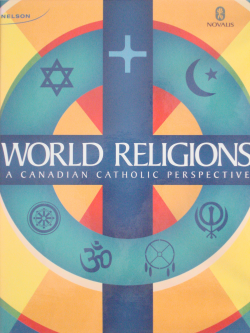
TEXT: World Religions: A Canadian Catholic Perspective This course engages students in the examination of world religions, particularly Judaism, Christianity, Islam and the First Nations, Métis and Inuit Spiritualities and a locally appropriate religious tradition. This is a survey course that will help students understand the basic similarities and differences between the religious traditions so they can interact with others with acceptance and familiarity. We live in a multi-faith global community. With the knowledge of this course, students ought to be able to understand more clearly the world’s religious affairs. |
| Grade 12 - Church and Culture |
|
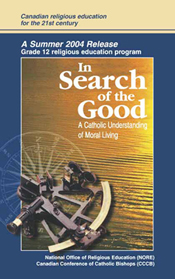
TEXT: In Search of the Good: A Catholic Understanding of Moral Living (CCCB) This course enables students to deepen their understanding of how the Church engages contemporary culture with faith and reason, in pursuit of love, justice, and the common good. Students will have opportunity to learn how living the Baptismal vocation to a virtuous life, filled with the joy of the Gospel and nurtured by the sacraments, can transform them and society from within, allowing God to reign in human hearts. Students will also refine research and inquiry skills.
Click on Catholic Companion to Equity and Social Justice Grade 12 University/College HSE4M to access the Institute for Catholic Education guideline for this course. |
Programs
| First Reconciliation - Celebrate and Remember First Reconciliation, St. Mary's Press |
| The Celebrate and Remember First Reconciliation program captivates children with: an opening prayer; We Listen: a Scripture story with an on-page activity; We Learn: doctrinal instruction with an on-page activity; Heart-to-Heart: an experiential story that shows how the Scripture and doctrine can be lived out; We Pray: a closing prayer celebration. Special chapter features include: key words bolded and defined in the glossary; take-home activities; sidebars that explore the saints, unique aspects of our faith, and the signs and symbols of our faith. The program also contains an illustration of the Reconciliation Room, a step-by-step guide to the Sacrament of Penance and Reconciliation, with instructions for preparing for it, an age-appropriate examination of conscience, traditional Catholic prayers, and an illustrated glossary. |
| First Eucharist - Celebrate and Remember First Eucharist, St. Mary's Press |
| The Celebrate and Remember First Eucharist program captivates children with: an opening prayer; We Listen: a Scripture story with an on-page activity; We Learn: doctrinal instruction with an on-page activity; Heart-to-Heart: an experiential story that shows how the Scripture and doctrine can be lived out; We Pray: a closing prayer celebration. Special chapter features include: key words bolded and defined in the glossary; take-home activities; sidebars that explore the saints, unique aspects of our faith, and the signs and symbols of our faith. The program also contains: a visual walk-through of a Catholic church, traditional Catholic prayers, a step-by-step guide to the Rite of the Mass, instructions for the reception of Holy Communion, and an illustrated glossary. |
| Confirmation - Chosen: Your Journey Towards Confirmation, Ascension Press |
| The goal of the program is to offer a powerful, life-changing experience as the candidate prepares to receive the Sacrament of Confirmation. The program covers the major tenets of the faith while inviting the candidate to grow in love of God, willingness to serve Him and openness to His Call. The program will be further enhanced with a Mass Journal of reflections, an Apostolic Service Project, a day of retreat, a letter to His Excellency and a Confirmation Saint Project. |
| Catechesis of the Good Shepherd |
| The Catechesis of the Good Shepherd is a catechetical program for children aged 3-12 years that is based on the Bible and liturgy of the Church. |
Family Life Education
| Grades 1 - 8 |
|
In grades 1 through 8 in Ontario Catholic schools, the program used for instruction in Family Life Education is Fully Alive. Fully Alive is a Family Life Education program sponsored and approved by the Assembly of Catholic Bishops of Ontario. Family Life Education, as it is represented in Fully Alive, is intended to pass on a distinctively Catholic view of human life, sexuality, marriage, and family. Its goal is to complement the efforts of families and to support what parents are doing at home. The entire program from Grades 1 through Grade 8 is designed to encourage children to become the people God wants them to be -- to be fully alive. Fully Alive is organized around five themes that are seen as essential to a complete Family Life Education program: Theme One - Created and Loved by God The first theme provides the foundation of the program. We are created in the image of God, and God loves and sustains each one of us. This theme explores some of the ways in which each person is unique and irreplaceable, yet shares a common human nature with all others. Theme Two - Living in Relationship Human beings are created to live in relationships with others. The bonds of family and friendship, which are explored in this theme, are central in our lives, and shape our identity and development. Theme Three - Created Sexual: Male and Female Sexuality is a fundamental dimension of our identity as children of God. In this theme, sexuality is presented as a gift from God that is intended for life and love. Theme Four - Growing in Commitment God's call to faithfulness is explored in this theme. Learning to be committed and trustworthy is a life-long challenge that begins in childhood. Theme Five - Living in the World Our relationships with others go beyond the circle of family and friends. Theme five examines what it means to participate in society, and to fulfill our responsibilities to care for and build God's world. |
| Grades 9 - 12 |
|
Catholic Family Life Education in Grades 9 through 12 is a multi-disciplinary curriculum area, designed to promote the Christian formation of adolescents in authentic human values related to personhood. The bishops of Ontario have identified Family Life Education as a required curriculum strand comprising approximately twenty percent of the Religious Education curriculum at the secondary level, since both areas are concerned with the integration of Gospel values into the whole pattern of human life. Classroom instruction in Family Life Education provides opportunities for the holistic formation of students in the Catholic Tradition. This strand draws upon the disciplines of theology, life sciences, and the social sciences. Within these, moral theology, biology, and developmental psychology are especially significant. Students study three areas in Family Life Education (Personhood, Relationships, and Sexuality), to support the direction given in the OCCB's 1996 message to the Catholic Education community, entitled, Family Life Education for Secondary Students. Family Life Education therefore is a distinctive feature of Religious Education in Catholic secondary schools in its biological, medical, psychological, and moral aspects. It is the intention of Family Life Education to assist students in the development of understanding and personal attitudes toward the Christian vision of human relationships and sexuality as integral to the person, created in the image of a life-giving and loving God. (Ontario Catholic Secondary Curriculum Policy Document 9-12, Introduction) |