


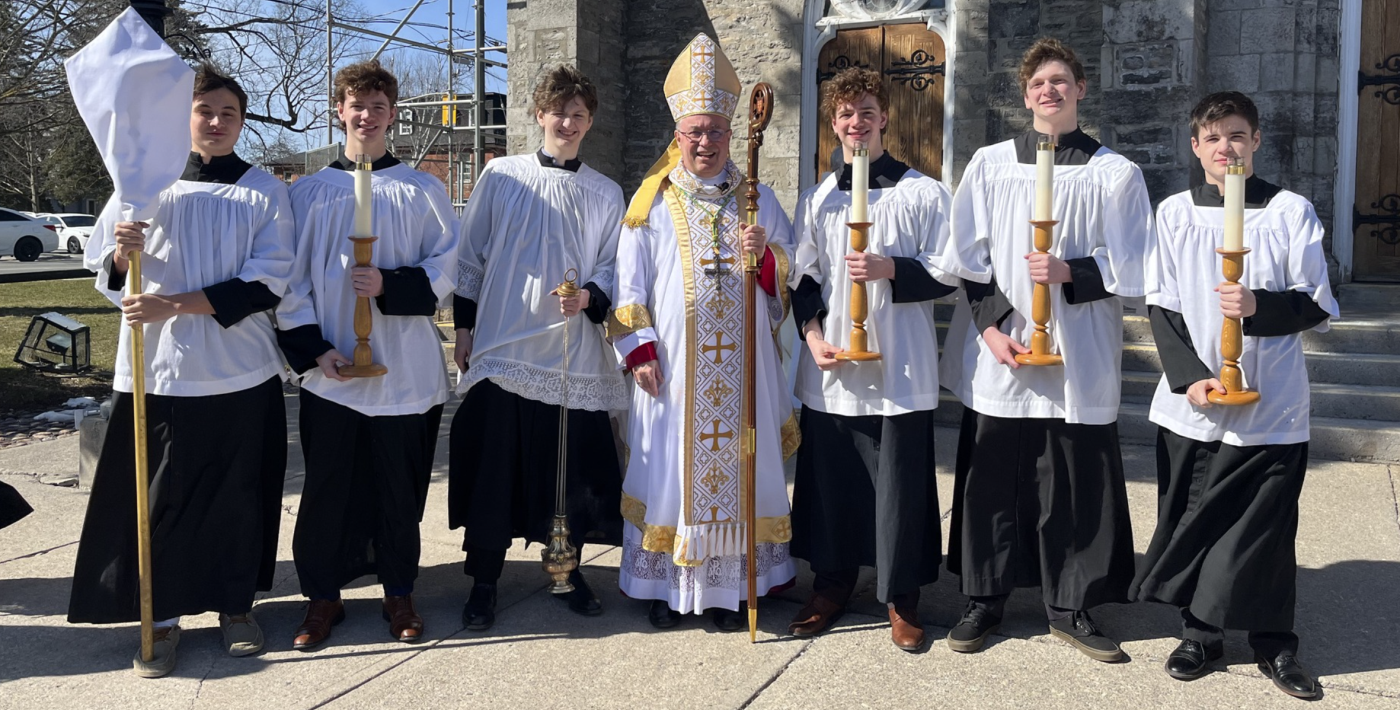


Altar Server
An altar server is a lay assistant to a member of the clergy during a Christian liturgy. An altar server attends to supporting tasks at the altar such as fetching and carrying, ringing the altar bell, helping bring up the gifts, and bringing up the liturgical books, among other things. Altar servers are sometimes called acolytes in the Roman Catholic Church.
The General Instruction of the Roman Missal, which does not use the term "server" and instead speaks of altar servers generically among "other ministers", treats in detail the specific functions of the "acolyte", and specifies other distinct functions for the "instituted acolyte".
The 1983 Code of Canon Law altered the juridical situation: without distinguishing between male and female, it declared: "Lay persons can fulfill the function of lector in liturgical actions by temporary designation. All lay persons can also perform the functions of commentator or cantor, or other functions, according to the norm of law." On June 30, 1992, the Pontifical Council for the Interpretation of Legislative Texts issued an authentic interpretation of that canon declaring that service of the altar is one of the "other functions" open to lay persons in general, without distinguishing between male and female. In reference to this authentic interpretation, the Congregation for Divine Worship and the Discipline of the Sacraments sent on March 15, 1994 a circular letter to presidents of episcopal conferences, clarifying that the canon in question is of permissive character. It permits the use of female altar servers but does not require it.
To serve at the altar for liturgical celebrations is a great opportunity to increase your faith and knowledge of the Sacrifice of the Mass. The Sacrifice of the Mass is the greatest event in the world and your job as an altar server is to assist the priest so that Sunday Mass runs smoothly and parishioners can pray and worship better and with less distraction.
In order to be an altar server, you must be a practicing Catholic female or male and must attend the training sessions offered at your parish.